
Gwinnett County Criminal Docket Searches
The official Gwinnett case-search page is the right starting point. It sends Superior, State, and Magistrate matters into the Tyler Odyssey Gwinnett Courts Portal. You will need JavaScript, cookies, and a free account. The portal’s notice requires all three. Recorder’s Court runs a separate search. So do city courts and federal PACER. When you have a case number from a notice, use it exactly. Gwinnett has published no single safe county case-number mask. A guessed year or prefix can bury the correct result.
Name searches are fuzzier. Before treating a match as your matter, confirm the court, filing period, charge, and setting. If Odyssey lets you down, call Tiana P. Garner’s Clerk of Court at 770-822-8100. You can also come to the counter at the Gwinnett Justice and Administration Center, 75 Langley Drive. Criminal preliminary matters handled at the jail annex may need the Magistrate criminal clerk. That number is 770-619-6720.
- Identify the court from the accusation, indictment, summons, citation, or hearing notice.
- Open Odyssey for Superior, State, or Magistrate data, or Recorder’s eCourt for a county citation.
- Enter the exact case or citation number, or compare name-search details with care.
- Read events in date order and compare the newest setting with prior resets.
- Ask the proper clerk for a document or certified copy when the portal is not enough.
Gwinnett Criminal Portal Routes
Criminal records divide by agency and court. Superior Court is where felonies ride. State Court takes misdemeanors plus its own traffic cases. Magistrate Court handles warrants, first appearances, bond-related early proceedings, and felony preliminary hearings. Traffic and county-code citations from designated county and state agencies go through the Recorder’s Court Public Access portal. A citation written by a city stays in that municipal court unless a later appeal or transfer opens a separate county record.
| Matter | First route | Custodian |
|---|---|---|
| Felony trial | Gwinnett Courts Portal | Superior Court clerk |
| Misdemeanor | Gwinnett Courts Portal | State Court clerk |
| Warrant or preliminary hearing | Portal, calendar, or clerk | Magistrate clerk |
| County citation | Recorder’s eCourt | Recorder’s clerk |
| City citation | Issuing city court | Municipal clerk |
Federal charges arising in Gwinnett land elsewhere. They belong to the Northern District of Georgia on PACER/CM-ECF, not on a Gwinnett County Clerk docket.
Criminal Dockets: What They Show
Most Gwinnett County criminal dockets open with a case header. Court, division, parties, attorneys, and filing data sit at the top. The dated history below can cover a lot. It can show charging papers, appearances, settings, motions, orders, pleas, trial events, sentence information, revocation activity, disposition, and appeal. Not every field appears in every public view. A docket entry can exist without a downloadable image. A calendar lists settings only.
| Case number | Use the exact number printed on the notice; no single county mask is confirmed. |
|---|---|
| Charge | The alleged offense, sometimes with a code section or classification. |
| Setting | An arraignment, calendar call, preliminary hearing, trial, sentencing, or reset. |
| Plea | The recorded response to a charge, where publicly available. |
| Disposition | The outcome and date, which may include dismissal, plea, judgment, sentence, or appeal. |
The official search disclaimer is blunt. Information is believed accurate and current but not guaranteed, so order a clerk-certified copy when you need an official result.
Gwinnett Criminal Calendar Calls
A calendar call is not the trial. Gwinnett’s State Court criminal jury calendar sample lists the calendar-call date and time apart from the later jury-trial week. It also shows division, judge, courtroom, attendance instructions, announcement deadline, case position, and accusation reference. The full docket can hold much more. Compare the posted calendar against the latest docket entry and the newest notice the court sent you.
The State Court calendars page lets you filter by Case Type, Judge, and title or filename. Parts load dynamically, though. Magistrate posts calendars for warrants and felony preliminary hearings. Gwinnett cautions that calendar dates are not official until transmitted to the parties. If a PDF and a notice disagree, call the division. A reset only moves a setting. It never dismisses the criminal case or erases the earlier Gwinnett County docket entry.
Criminal Case Stages on the Docket
What shows up first depends on the court. A felony may open with a warrant, first appearance, bond, or preliminary hearing before any indictment reaches Superior Court. A State Court misdemeanor might begin with an accusation, entry of appearance, waiver, and arraignment setting. Later entries bring the paperwork. Expect discovery notices, motions, orders, continuances, calendar calls, plea or trial, sentencing, probation or revocation, and appeal documents.
Gwinnett docket flow: Filing or charge › Initial proceeding › Arraignment › Pretrial settings › Plea or trial › Disposition › Sentence or appeal
One stage can spawn several events. A filing label alone proves nothing about what a judge granted. Read the next order and the final disposition instead of guessing from a motion title.
Gwinnett Criminal E-Filing Timeline
Criminal e-filing arrived in Gwinnett through Tyler Odyssey eFileGA on June 24, 2020. The county’s criminal e-filing release opened the door. It allowed attorneys and self-represented parties to file into existing criminal cases. Once the clerk accepts an electronic filing, it imports into case management. The docket notes the entry. Paper takes longer, since staff must scan or key it in.
That sequence explains a familiar gap. Uploading is not clerk acceptance. A new event may lag behind your submission. Check the filing receipt first, then the docket after processing. If a time-sensitive item still has not appeared, call the criminal division. Have the case number and filing details ready. Do not file it again just because the public screen is slow to refresh.
The official Gwinnett eFileGA page routes filers to the system and vendor support. Treat it as a filing channel, not a broad public search.
Gwinnett County Criminal Docket Courts
Felony trials in Gwinnett County belong to the Georgia Superior Court, Gwinnett Judicial Circuit, the court of general jurisdiction. Misdemeanors and traffic cases go to Gwinnett County State Court. Warrants, first appearances, and preliminary hearings start in Magistrate Court. A felony case heard there early on still moves up for trial. Recorder’s Court and the municipal courts split the rest. Each holds the citation and ordinance records that fall to it.
One elected clerk keeps the Superior, State, and Magistrate criminal files under a unified structure. Recorder’s Court Clerk Jeff C. West and the municipal clerks each maintain their own records. Juvenile Court runs on a restricted lane. Watch for transfers and appeals. Either can open a new docket and case number in a second court. A full history means searching both.
Gwinnett Criminal Terms in Context
No single countywide event-code dictionary exists for Gwinnett. Read the whole event label in the live portal, and ask the clerk when an abbreviation stays unclear. The plain terms here cover common events, not a claim that one shorthand shows up in every division.
- Accusation
- A charging document commonly tied to a State Court prosecution.
- Arraignment
- A setting where the charge is formally addressed and a plea or waiver may be taken.
- Continuance
- A delay that keeps the old setting in the history and moves the matter.
- Calendar call
- A session used to call cases and assess readiness, often before trial week.
- Disposition
- The recorded outcome, such as dismissal, plea, judgment, sentence, or other final action.
A capias or warrant entry can show that process issued or was recalled, yet protected details may sit outside the public view. And do not expect a bond field on every calendar or result. When it appears, treat it as one data point, not a promise.
Access Rules for Criminal Dockets
Court rules, statutes, and case-specific orders govern what the public can reach in Gwinnett. Uniform Superior Court Rule 21 sets out access limits, and Rule 21.6 demands care with personal identifiers. So a public docket may display a header, events, setting, and disposition while a document stays redacted, restricted, sealed, or available only through the clerk.
Key access rules:
Uniform Superior Court Rules 21 and 21.6 govern access limits and redaction of protected identifiers.
O.C.G.A. §15-11-704 generally limits inspection of juvenile files unless an exception or court order permits it.
Georgia Open Records guidance explains exemptions and redaction, but the county portal is not the request route for Superior, State, or Magistrate clerk files.
An empty result does not prove the file is absent. Check the court again, the spelling, the number, and whether the matter sits in a city, Recorder's, juvenile, or federal forum. Then ask the custodian of the record whether access is restricted or the entry is still pending.
Gwinnett Criminal Forms and Records
The State Court forms index collects appointed-counsel requests, consent to video appearance, probation intake, waiver of arraignment, waiver of counsel, change of address, waiver of rights, the back of accusation, and first-offender sentencing. A form is not a docket, though. Only filing and acceptance produce a docket entry.
That same official page sorts material into civil, criminal, dispossessory, garnishment, and Rule 22 groups, so pick the right group before you download. View the Gwinnett State Court forms page.
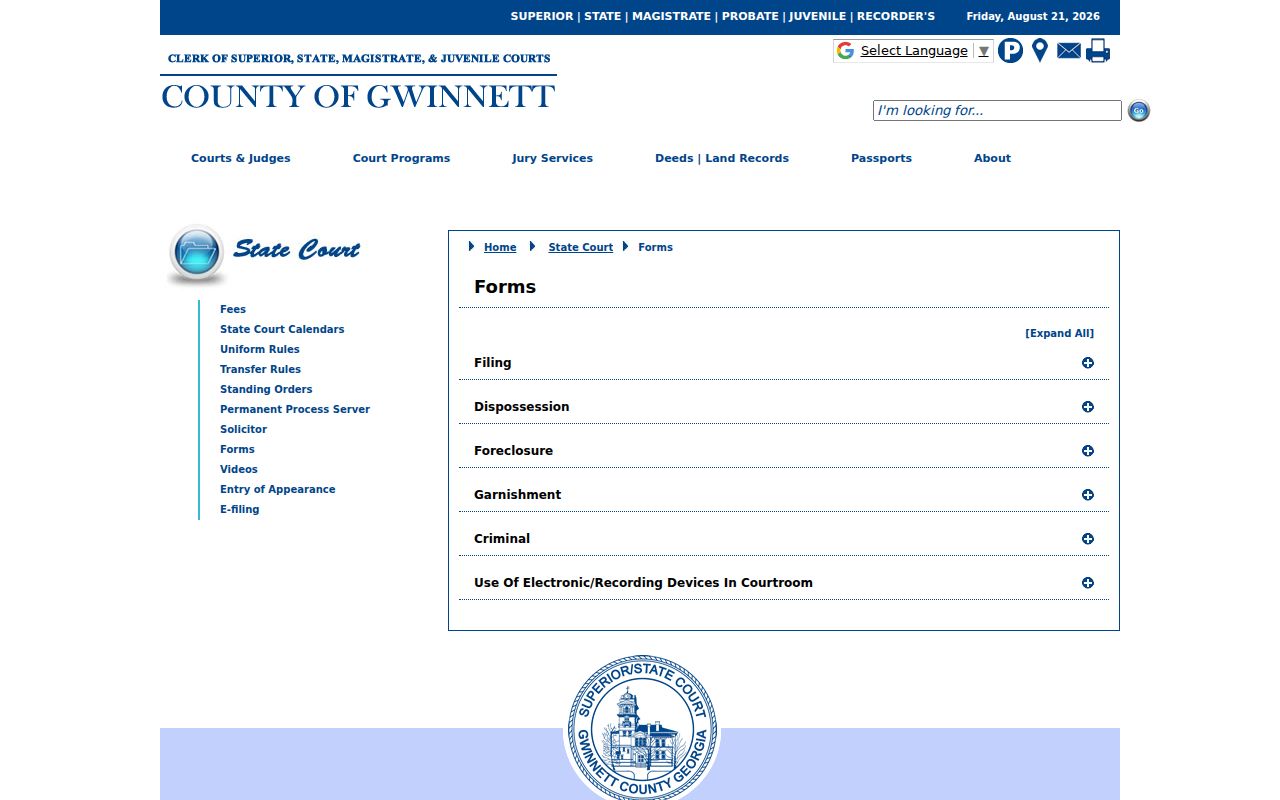
The grouped forms reinforce the routing rule: confirm the resulting event in the correct Gwinnett County criminal docket.