
Gwinnett County Civil Docket Searches
The Gwinnett Courts case-search page connects to the Tyler Odyssey portal. It covers Superior, State, Magistrate, and Probate Estate matters. The portal asks for a free account, JavaScript, and cookies. If a summons, filing, order, or notice gives you a case number, type it exactly. Gwinnett publishes no single universal civil case-number pattern, so guess no prefix or year format.
Sort out the court before any name search. Divorce, title disputes, and equity belong to Superior Court. An ordinary civil suit not reserved to Superior sits in State Court. Smaller claims, dispossessories, and garnishments go to Magistrate, while estates stay with Probate. When results come back, check the match carefully. Review filing date, case style, parties, attorneys, and the newest event before you trust it.
- Choose Superior, State, Magistrate, or Probate Estate based on the subject and notice.
- Open Odyssey and sign in with the required free account.
- Use the exact number, or search a party name and compare case details.
- Read the newest docket event and check the current calendar for a setting.
- Call 770-822-8100 or visit the proper clerk counter if a record is missing.
Gwinnett Civil Courts Compared
What relief a party seeks decides the docket. Superior Court holds general civil authority plus exclusive categories like divorce, land title, and equity. State Court takes civil actions not reserved to Superior. Magistrate Court caps claims at $15,000. It handles dispossessory, garnishment, distress, and county-ordinance proceedings, with no jury trials. Probate keeps estates and guardianships in their own record lane.
| Court | Gwinnett civil lane | Access |
|---|---|---|
| Superior | Domestic, title, equity, and general civil jurisdiction | Odyssey and Clerk |
| State | Ordinary civil actions not reserved to Superior | Odyssey and Clerk |
| Magistrate | Claims up to $15,000, dispossessory, garnishment | Odyssey and calendars |
| Probate | Estates and guardianship records | Odyssey/re:SearchGA and Probate |
A city municipal court cannot handle an ordinary county lawsuit. Federal civil cases run through Northern District PACER/CM-ECF instead.
Civil Dockets: What They Show
Think of a Gwinnett County civil docket as a dated event register. It is not the entire case file. It can show the court, division, judge, case type, filing date, parties, attorneys, and attorneys' service, answer, motions, orders, mediation, settings, continuances, judgment, costs, appeal, and related cases. Amount or claim details may appear where the system allows. Not every field or image is guaranteed.
| Case number | The exact court identifier, as printed on the record, with no universal mask confirmed. |
|---|---|
| Parties | Plaintiff or petitioner and defendant or respondent, plus counsel where shown. |
| Case type | General civil, domestic, garnishment, dispossessory, foreclosure, or another court label. |
| Events | Service, answer, motion, order, mediation, setting, continuance, and dated activity. |
| Outcome | Judgment, dismissal, disposition date, costs, or appeal information where public. |
A case style names the parties and nothing more. A motion entry means a request was filed; it does not mean the judge granted it.
Gwinnett Forms Feed Civil Dockets
Forms create or support docket events. The Superior Court forms page covers Domestic Relations Case Filing Information Form 20 and Final Disposition Form 21. It also lists divorce reports, financial affidavits, parenting plans, service papers, judgments, and mediation materials. State Court posts general civil filing and final disposition forms. Summons, publication notices, service certificates, garnishment materials, and a petition for review from Magistrate appear there too.
The official Superior Court forms index groups items under ADR, domestic, filing, service, and courtroom recording. Those labels help decode a docket entry. The index itself is not the docket, though. View the source for the Gwinnett civil forms capture.
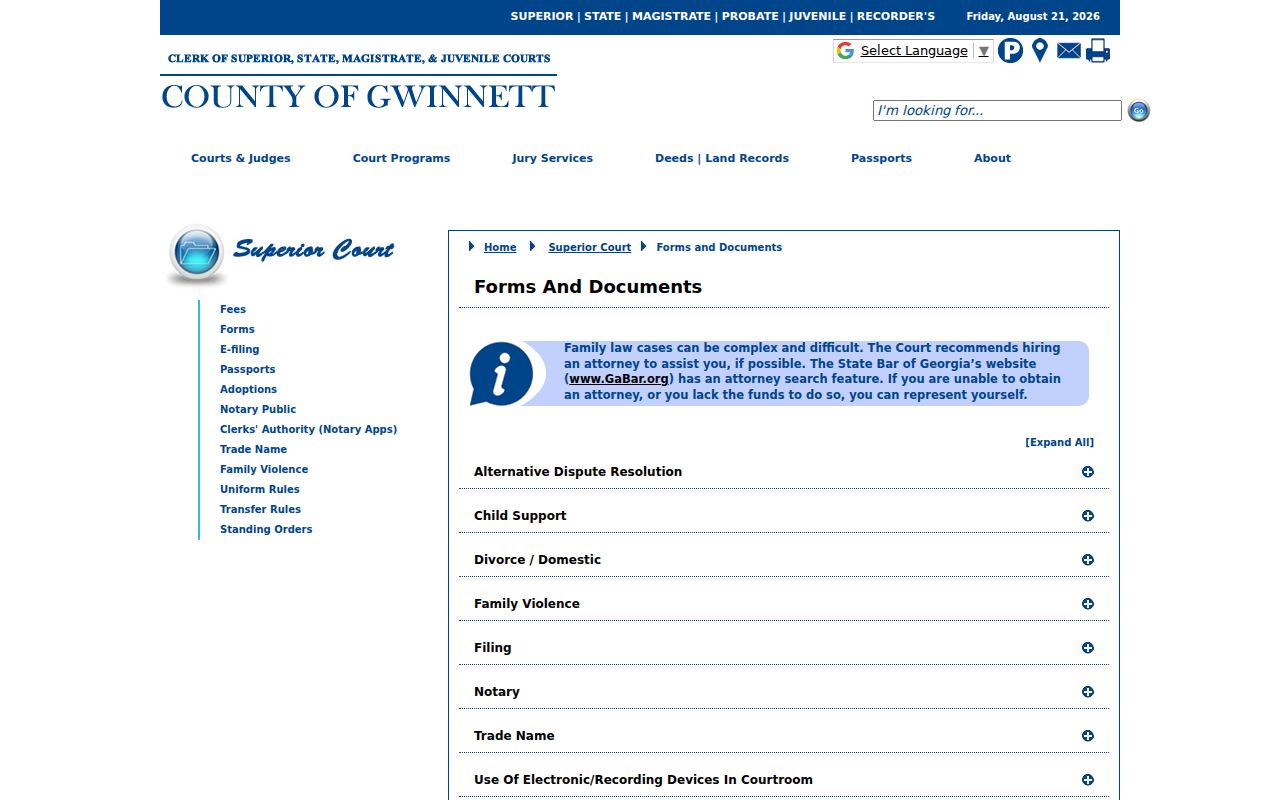
One distinction matters here. A form joins the Gwinnett County civil docket only after the clerk accepts and records it.
What Cases Fill the Civil Docket
Superior Court dockets carry domestic relations, land title, equity, and other major civil matters. State Court hears civil actions across its county-wide authority. Superior does not claim those. Magistrate dockets hold smaller claims, dispossessory cases, garnishments, distress matters, and certain county ordinance proceedings. Probate records cover estates and guardianships. They do not hold ordinary plaintiff-versus-defendant suits.
- General civil: claims and requests for relief within Superior or State authority.
- Domestic: divorce and related filings assigned to Superior Court.
- Property and equity: title and equitable matters reserved to Superior Court.
- Magistrate claims: civil demands of $15,000 or less.
- Summary proceedings: dispossessory, garnishment, and other Magistrate groups.
The case-type label tells you where calendars and forms live. If Odyssey returns several matches, compare the court and category before opening the event history.
Gwinnett Magistrate Civil Boundary
Gwinnett Magistrate Court sets a $15,000 limit on civil claims. It runs separate calendar routes for dispossessory, default, no-service, contested, and garnishment settings. No jury trials happen there. A case outside that lane, or a later review or appeal, can open activity elsewhere. That other Gwinnett court uses a different number.
The Magistrate trial-calendar index fills gaps when Odyssey shows an event but little setting detail. Match the category first, then confirm the date against the current notice. The Magistrate civil judge division answers at 770-822-8088, and the unified clerk number is 770-822-8100.
Key point: A filing limit identifies a court lane. It is not a copy fee, judgment amount, or promise that the case stays there after review.
Hearings on the Civil Docket
A civil history may list a motion hearing, calendar call, bench trial, jury trial, or default. It may show no-service, dispossessory, garnishment, mediation, or another division setting. A reset or continuance moves the event. The old date still sits in the history. Read the newest dated entry and compare it with the latest summons, notice, or clerk transmission.
The State Court civil jury calendar sample lists court and division, judge, and calendar-call and trial or disposition dates. It also gives courtroom instructions, case position, case style, attorney information, and readiness or continuance instructions. That sample is not the full docket. Gwinnett warns that online calendar dates are unofficial until transmitted to the parties. Confirm any critical setting with the assigned division.
Note: A posted civil calendar helps with planning, but the newest clerk notice controls when an older PDF shows a different setting.
Gwinnett Docket Versus Case File
A Gwinnett County civil docket entry and the paper behind it are two different things. The docket tells you a filing happened. It may list a complaint, an answer, a financial affidavit, a parenting plan, an order, an exhibit, or a judgment. The page itself stays out of view. To read the actual document, Gwinnett points filers to the account-based re:SearchGA portal, which handles documents and searches that reach beyond one county. Expect a cost either way. A vendor charges its own price for an image. A clerk copy costs whatever that court’s fee schedule sets.
| Layer | What it establishes | What it cannot replace |
|---|---|---|
| Docket event | An event or filing was recorded | The full filed text |
| Calendar PDF | A posted setting and division | The complete history |
| Document image | Filed text available through vendor or clerk | A certified copy |
| Certified copy | An authenticated court record | Legal advice about its effect |
Ask for a complaint or judgment by case number and document title. Printouts from a portal screen are not certified judgments.
Who Can See Civil Dockets
Most Gwinnett County civil docket entries are public. Headers and event histories can be viewed by anyone. The catch is scope. Uniform Superior Court Rule 21 sets the access limits. Rule 21.6 requires personal identifiers to be redacted. Domestic files often hold sensitive family or financial details, so pieces may stay shielded. Adoption and certain child-related matters can be restricted outright. A docket result may also list a case while one or more of its images stay held back.
Where do exemptions come from? The Georgia Attorney General’s Open Records guidance walks through exemptions, redaction, and what agencies may charge to produce records. One wrinkle matters here. Gwinnett County’s general Open Records portal expressly excludes Superior, State, and Magistrate clerk records. Send those requests to the Clerk of Court instead. Keep the county portal for the departments it actually covers.
A case missing from the docket search deserves a second pass. Check the court, the party spelling, the case number, the filing period, and whether the matter sits in Probate, federal court, or a restricted category. If it still will not appear, ask the clerk whether entry, scanning, redaction, or an access order is blocking the public view. Certified copies come only from the court that keeps the original file.
Gwinnett Civil Fees by Lane
Filing fees in Gwinnett County depend on the court and the case type. Superior Court lists $215 for a new civil or family filing. A divorce costs $220. A family-violence petition costs $0. State Court charges $217 for a new civil filing and $165 for a small civil action. Magistrate Court lists $60 plus service for a civil filing. It charges $60 plus service for a dispossessory. Treat these as examples, not a price list for every filing.
Someone pulling an existing Gwinnett County civil docket owes none of that. Filing fees belong to the person starting a case, not to a person reading one. Certified-copy charges vary by court, and a re:SearchGA document price is a separate vendor cost. Before requesting a record, check the Superior Court fee schedule or the schedule for the specific court involved.
For free access, the chain runs in order. Start with Odyssey. Then try the newest docket event and calendar, then the clerk by phone, then the GJAC counter or lobby computer, and only then a copy request. Probate public estate files follow their own records route. Federal civil files live in PACER/CM-ECF.