
Gwinnett County Court Record Requests
Superior, State, and Magistrate files all sit with one office. Tiana P. Garner, Clerk of Court, holds them at the Gwinnett Justice and Administration Center. No case number yet? Run a Gwinnett docket search first. Then ask the clerk for the specific pleading, order, judgment, or certification you need. The public counter sits at 75 Langley Drive, and the phone line is 770-822-8100.
- Identify the court and copy the case number exactly.
- List each document or date range instead of requesting an undefined “whole file.”
- State whether a plain or certified copy is needed.
- Ask whether the item is in Odyssey, re:SearchGA, a scanned file, or retained paper.
- Confirm the published fee and delivery method before payment.
- Use the separate Probate, Recorder, municipal, or federal route when that office holds the case.
A phone call or letter works well for shaping a request. Older files that were never digitized usually take a counter visit. A registered re:SearchGA account lets you buy documents online, but only the clerk can certify them.
Why Gwinnett Splits Custody
Custody in Gwinnett is split by design. The elected Clerk keeps Superior, State, Magistrate, and Juvenile civil and criminal records, while Probate handles estates, guardianships, licenses, and its own archives. Recorder’s Court holds county traffic and county-code citations. Municipal files belong to the city clerks. So a case tied to Gwinnett geography is not automatically a Clerk record.
| Record | Custodian | Primary channel |
|---|---|---|
| Superior, State, Magistrate | Gwinnett Clerk of Court | Portal, counter, 770-822-8100 |
| Public estate file | Probate Court | re:SearchGA, email, counter, mail |
| County citation | Recorder’s Court | eCourt, phone, certified request |
| City citation | Municipal clerk | City-specific request |
The Clerk’s official page explains the unified county clerk structure and division duties.
Kinds of Court Records
These terms get mixed up constantly. A docket is the chronological register of a case, and a calendar lists what the court has scheduled. The filed document is the real pleading, motion, order, or exhibit accepted into the file, while a certified copy adds the clerk’s authentication. None of these are interchangeable.
- Case headers and chronological docket entries
- Complaints, petitions, accusations, motions, and responses where public
- Orders, judgments, decrees, dispositions, and sentencing records
- Hearing notices, calendars, service returns, and related filing events
- Plain document copies and clerk-certified copies
Superior and State form indexes show just how wide the holdings run, from civil and domestic filings to criminal, service, and disposition materials. What you can actually see still depends on the case on file and the access rules that apply.
Gwinnett Probate Archive Access
Probate runs its own archive lane. Historical books have been digitized for online viewing. Lobby computers carry them too. Physical books can be requested on weekdays. The published window is 8:00 to 4:30. For public decedent estate files, use re:SearchGA. You can also bring a Records Request Sheet to the counter. Or mail the Probate Court Estates Division at 75 Langley Drive.
The official Probate records page shows the digitized archive. It also shows the request rules that govern it.
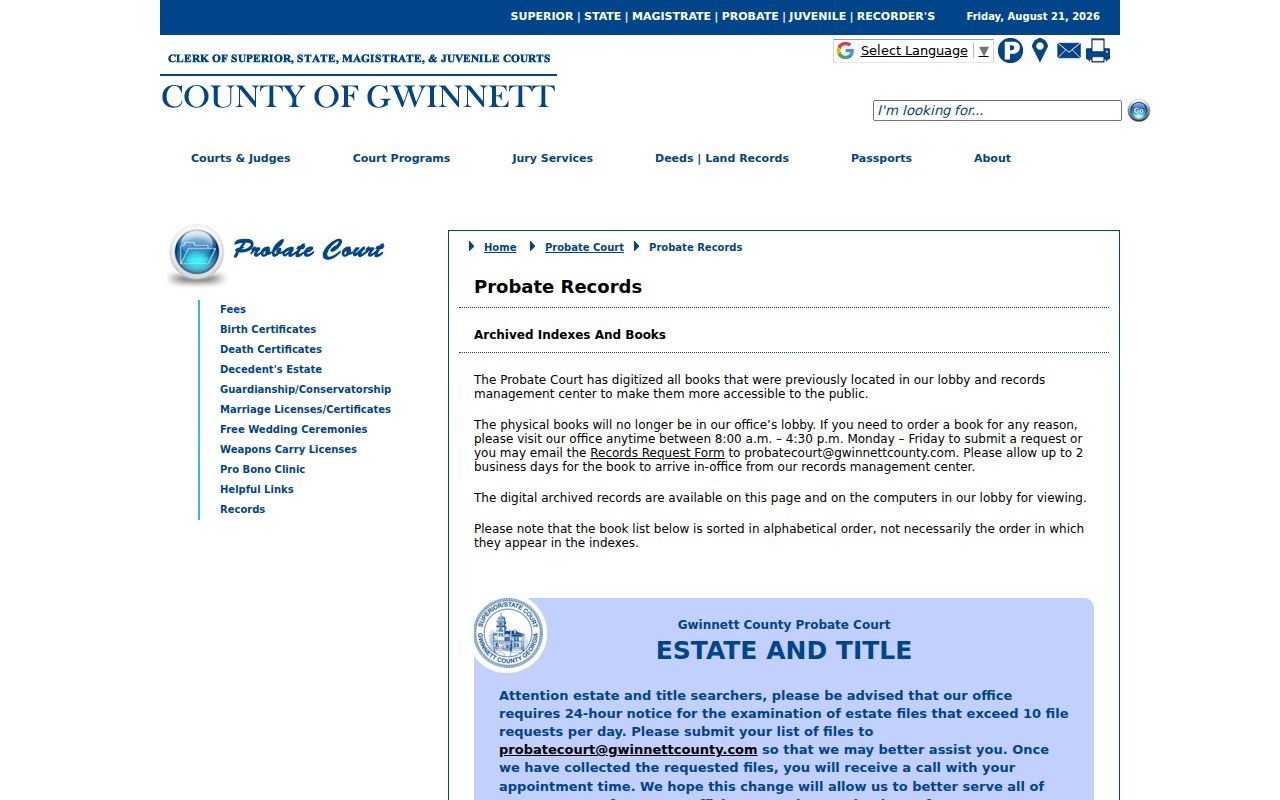
That separate Probate route matters. Staff may need up to two business days to pull a file from the records center. Want more than ten estate files in one day? Email a list first and give 24 hours’ advance notice.
Court Records: What They Contain
What a public Gwinnett County court case record contains varies. A well-formed file usually runs from the case header through dated filings to the outcome. Restricted material, or an image that is simply unavailable, can limit what shows up online.
| Header | Court, case number, type, status, and filing date where public. |
|---|---|
| Parties | Caption and attorneys of record, subject to access limits. |
| Entries | Chronological filings, orders, notices, settings, and continuances. |
| Documents | Public images or references to papers held by the custodian. |
| Disposition | Judgment, dismissal, plea, sentence, or other recorded outcome. |
| Related case | Appeal, transfer, or review references that may have a new number. |
A portal screen is not a certified record, so request the authenticated document when you need an official copy.
County Portal Is Not Universal
Gwinnett County’s general Open Records portal is not the channel for Superior, State, or Magistrate clerk court records. The county expressly excludes those files. It does list Recorder’s Court among its departments, though. Send the request to the wrong place, and you lose time. That holds even when the record is fully public. The official Gwinnett Open Records page spells out that scope.
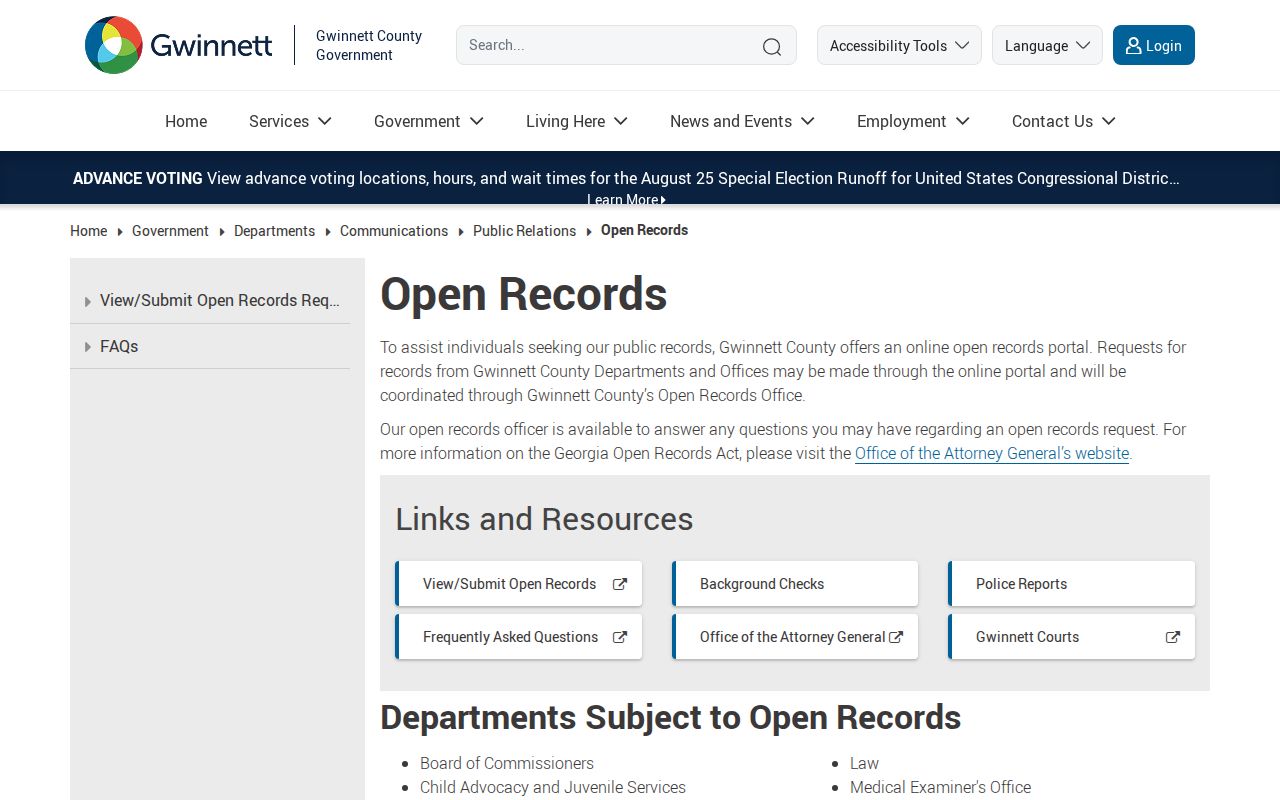
Departmental requests and court-clerk files are two different things. Go to the Clerk directly for Superior, State, and Magistrate records, and use the county portal only when the listed Recorder request fits.
Copy Fees and Certification
Fees shift with the court and the item, so verify the current court-specific schedule before ordering. Treat the amounts below as court by court, not as a countywide rule.
| Record route | Published amount or rule |
|---|---|
| Probate public estate copy | $1.00 per page |
| Georgia agency paper copy | Up to $0.25 per page under the cited Open Records guidance |
| Search and retrieval | Reasonable costs may begin after the first 15 minutes for agency requests |
| Superior, State, Magistrate certification | Use the current court-specific fee page |
Probate mail requests may ask for the name, any prior file reference, a self-addressed stamped envelope, and a check or money order. Before paying, ask the Clerk whether you truly need certification, exemplification, or another form of authentication.
Recorder Dispositions Can Expire
Recorder’s Court has a retention rule worth knowing. Its certified-disposition page states that disposed citation records are not kept forever. Court requirements must be met, and the retention period must run out. A missing disposition may simply mean lawful destruction. It does not mean a failed lookup.
Questions go to 877-794-0988 or recorderscourtinfo@gwinnettcounty.com. Include the name, case or citation number, and phone number. The official certified disposition request page explains one option. Supply a driving history identifying the citation as a Gwinnett Recorder matter. The clerk may then issue an unavailable-disposition letter.
Retention matters. Ask whether the disposition exists before assuming that an empty portal result means the citation never reached court.
Access Rules for Court Records
Uniform Superior Court Rule 21 governs access limits on court records, and Rule 21.6 covers redaction of personal identifiers. Georgia Open Records Act provisions reach public records too, along with costs, exemptions, and production of nonexempt portions. The Attorney General’s official FAQ walks through those agency rules.
Public does not mean unredacted. Social Security numbers, medical and financial data, bank or card information, and month and day of birth can be withheld or redacted while a public remainder is produced.
Some records face tighter limits. Juvenile files, sealed matters, adoption records, protected family filings, and certain Probate matters all carry stricter rules. A blank search result decides nothing. Ask the custodian whether the case is restricted, waiting to be scanned, or held outside the portal entirely.
Gwinnett Clerk of Court
Superior, State, and Magistrate records
75 Langley Drive, Lawrenceville, GA 30046
770-822-8100
The clerk can tell you where a record lives and how to copy it, but cannot give legal advice. Federal records stay with the Northern District clerk, not Gwinnett County.
Matching the Gwinnett Record Need
Shape the request around the need. Confirming a court date may take nothing more than the newest setting and its notice. Checking what a judge actually ordered calls for the entered order itself. A calendar row in the Gwinnett County court docket shows a hearing, not a result. Deep historical work may point to a full public estate file. A digitized Probate book may serve just as well. Order a certified copy only when authentication truly matters. It can add a distinct fee and its own handling process.
What you can see online may be narrower than the public file itself. A docket entry may state that an order was entered. It may still hold the image back from guest view. Ask the clerk whether the document is public and how to request it. A filing's title alone tells you little about its contents. A missing image does not mean the filing was withdrawn.
Gwinnett Records Request Details
Details save time. Give the court and the exact case number. Add the filing year, the document title, and the entry date if you know it. Include the copy type you want and a reliable contact method. For older Gwinnett County court records, ask whether staff must pull the file from a records center. Probate mail requests should confirm payment and stamped-envelope directions first. At Recorder's, keep a certified disposition separate from a search of active case data.
Municipal records follow city rules. Duluth publishes its own JustFOIA, email, and mail channels. Copy fees and staff-research terms come with them. None of that governs Lawrenceville, Sugar Hill, Suwanee, or Peachtree Corners. Each city's clerk and current schedule controls its own case lookup.