
Gwinnett County Court Docket Searches
Start at the official Gwinnett case-search landing page. Gwinnett splits its records by court system. Superior, State, Magistrate, and Probate estate cases live in the Tyler Odyssey Gwinnett Courts Portal. County traffic tickets and ordinance citations belong to Recorder's Court Public Access. Juvenile cases are mostly closed to the public. City citations stay with the issuing municipal court. Federal matters run through the Northern District of Georgia. Searching the wrong lane yields a blank screen. So a null result does not mean the Gwinnett County court docket you want is missing.
Before searching, have the court name handy. Bring the party name, case or citation number, filing year, and any notice too. Gwinnett uses no single county-wide case-number format. Type the number exactly as printed. The court's own homepage lists every division link and search route.
The official Gwinnett Courts source lays out that routing in context:
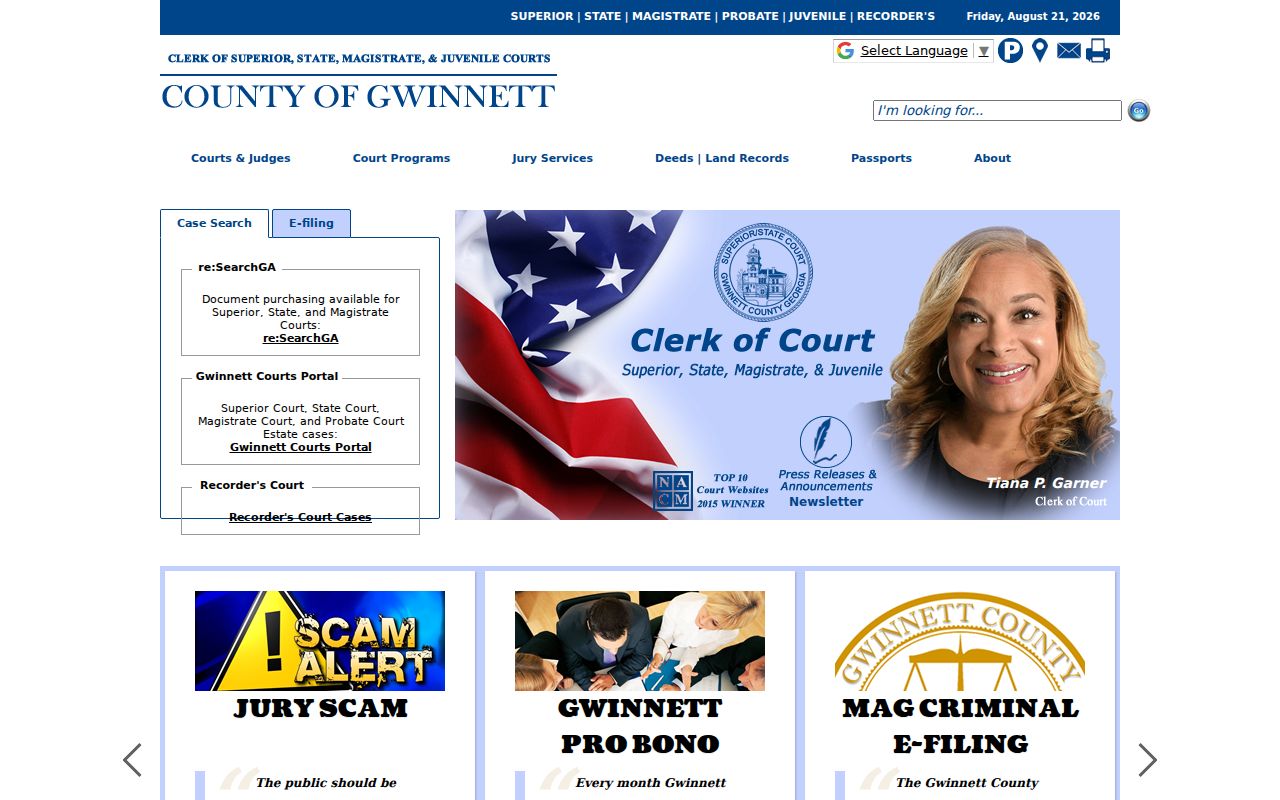
That official page helps you tell a division link apart from an actual docket result. Reach the right channel through it. Then, when timing matters, confirm the newest docket entry with the clerk.
- Identify the court from the citation, summons, pleading, or notice.
- Open Odyssey for the main county courts or eCourt for Recorder's Court.
- Search with the exact case number when one is available.
- Compare the newest docket event with any posted calendar.
- Ask the proper clerk for a plain or certified copy when proof is needed.
Three Gwinnett Docket Portals
Three doors lead into Gwinnett County court docket data: Odyssey, re:SearchGA, and Recorder's eCourt. The Gwinnett Courts Portal holds Superior, State, Magistrate, and Probate estate case records. Its own notice requires a free registered account to search, plus JavaScript and cookies. The static page hides some search fields. So assume nothing about wildcards, date ranges, exports, or free documents.
re:SearchGA adds a multi-county layer and sells documents after registration. It helps when a Gwinnett case sits inside a wider Georgia search. It also helps when a docket entry cites a document the county view will not open. Recorder's public eCourt form stands alone. Its inputs cover case number, citation number, name, and date of birth.
| Channel | Best Use | Known Limit |
|---|---|---|
| Odyssey | Main Gwinnett court case data | Free account and browser scripting required |
| re:SearchGA | Multi-county search and document access | Login and possible document purchase |
| Recorder eCourt | County traffic and ordinance citations | Document rules are not stated on the form |
Above the county sits a statewide directory, not one free search of every county. The Georgia Courts eAccess page points users toward county and vendor providers. The official statewide directory is visible in the manifest image:
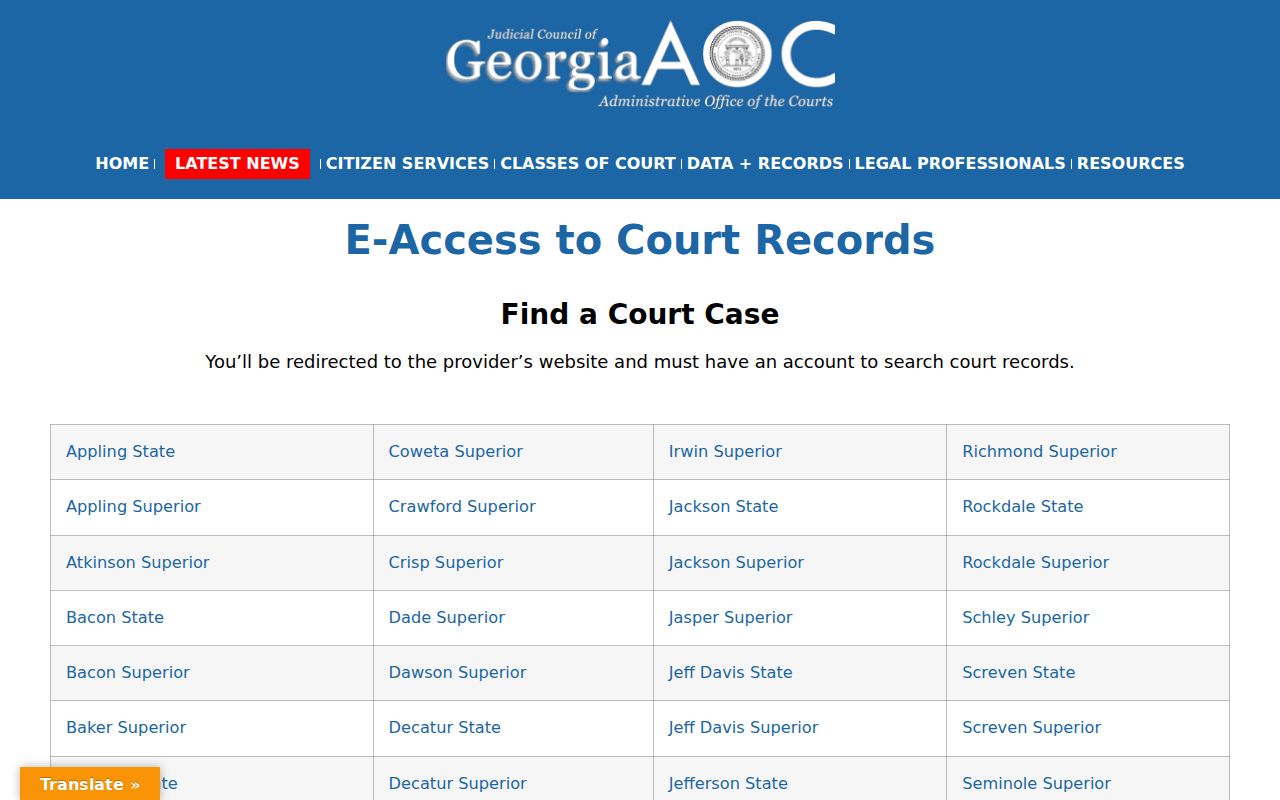
The state page routes searches. It does not host one complete statewide Gwinnett docket database, and nothing on it implies otherwise.
Court Dockets: What They Show
A Gwinnett County court docket is the chronological register of a case. It is not the whole case file. A public view may list the caption, the assigned court, and the judge. It may also show the filing date, attorneys, events, settings, orders, the disposition, and appeal references. Some entries name a filing without showing its image. Calendar PDFs give setting details but never replace the case register. When you need a certified judgment or disposition, get it from the clerk. The clerk is custodian of the record, not a screen print.
| Case number | The court's exact identifier. Gwinnett uses court-specific formats, so copy it from the source. |
|---|---|
| Case style | The caption naming the parties or the State and opposing party. |
| Docket entries | Dated filings, motions, notices, orders, and other case events. |
| Settings | Calendar call, hearing, trial, arraignment, or other scheduled event. |
| Disposition | The recorded outcome or status, which may require a certified copy for official use. |
| Documents | Images or links may be limited, redacted, account-gated, or sold through re:SearchGA. |
Work through entries in date order. A reset is not a dismissal, and a calendar call may precede trial week. An accepted filing can hit the register only after vendor processing or clerk review.
Gwinnett Dockets Went Digital
Gwinnett's own courthouse history dates its first judicial website to 1995. A database-driven update followed in 2005. Superior, State, and Magistrate cases have been online since that era. Civil e-filing became mandatory for Superior and State courts by 2019. Criminal e-filing started in June 2020. In February 2024, existing Magistrate criminal cases gained an optional electronic route.
Filing electronically does not mean instant public display. The county's criminal filing release explains that an accepted e-filing imports into case management and creates a docket notation. Paper documents wait for scanning and manual entry. So a new item can be pending even after counsel submits it. If something seems missing, keep the receipt. Check again and ask the Clerk rather than filing a duplicate just because the public Gwinnett County court docket has not refreshed.
Tyler Odyssey eFileGA handles filing. It is not the same product as the public portal. The Georgia Courts eFile directory lists filing access. For research, begin with the county case-search route.
Gwinnett County Courts and Their Dockets
Subject matter decides which docket a case lands on. Georgia Superior Court for the Gwinnett Judicial Circuit holds general jurisdiction. That means felony trials, divorce, title to land, equity, habeas, and specified reviews. State Court takes misdemeanors and its share of traffic matters. It also hears civil actions not reserved for Superior Court. Magistrate Court handles claims up to $15,000. Its work includes dispossessory and garnishment actions, warrants, first appearances, and preliminary hearings. Probate, Juvenile, Recorder's, and the municipal courts each keep their own records.
| Court | Docket Covers | Where to Search |
|---|---|---|
| Superior Court | Felonies, domestic cases, equity, major civil matters | Odyssey and Clerk |
| State Court | Misdemeanors, traffic, ordinary civil cases | Odyssey, calendars, Clerk |
| Magistrate Court | Small civil claims, dispossessory, warrants, preliminaries | Odyssey, calendar PDFs, Clerk |
| Probate Court | Estates, guardianships, probate archives | Odyssey, re:SearchGA, Probate office |
| Recorder's Court | County-agency traffic and county-code citations | Recorder eCourt and its clerk |
| Municipal courts | City traffic and ordinance cases | Issuing city's court |
Juvenile matters carry special access limits. A federal case tied to Gwinnett sits in PACER or Northern District CM/ECF, never in the county portal.
Three Gwinnett Docket Buildings
The Gwinnett Justice and Administration Center is known as GJAC. It sits at 75 Langley Drive in Lawrenceville. The Clerk, Superior, State, civil Magistrate, and Probate functions are all based there. Juvenile and Recorder's courts meet at the Traffic Court and Juvenile Justice Building. That address is 115 Stone Mountain Street. Magistrate criminal functions also run at the Detention Center court annex, 2900 University Parkway. These are distinct destinations, so confirm your site before heading out.
The GJAC history source documents a complex with a common atrium. It includes 27 courtrooms and support areas:
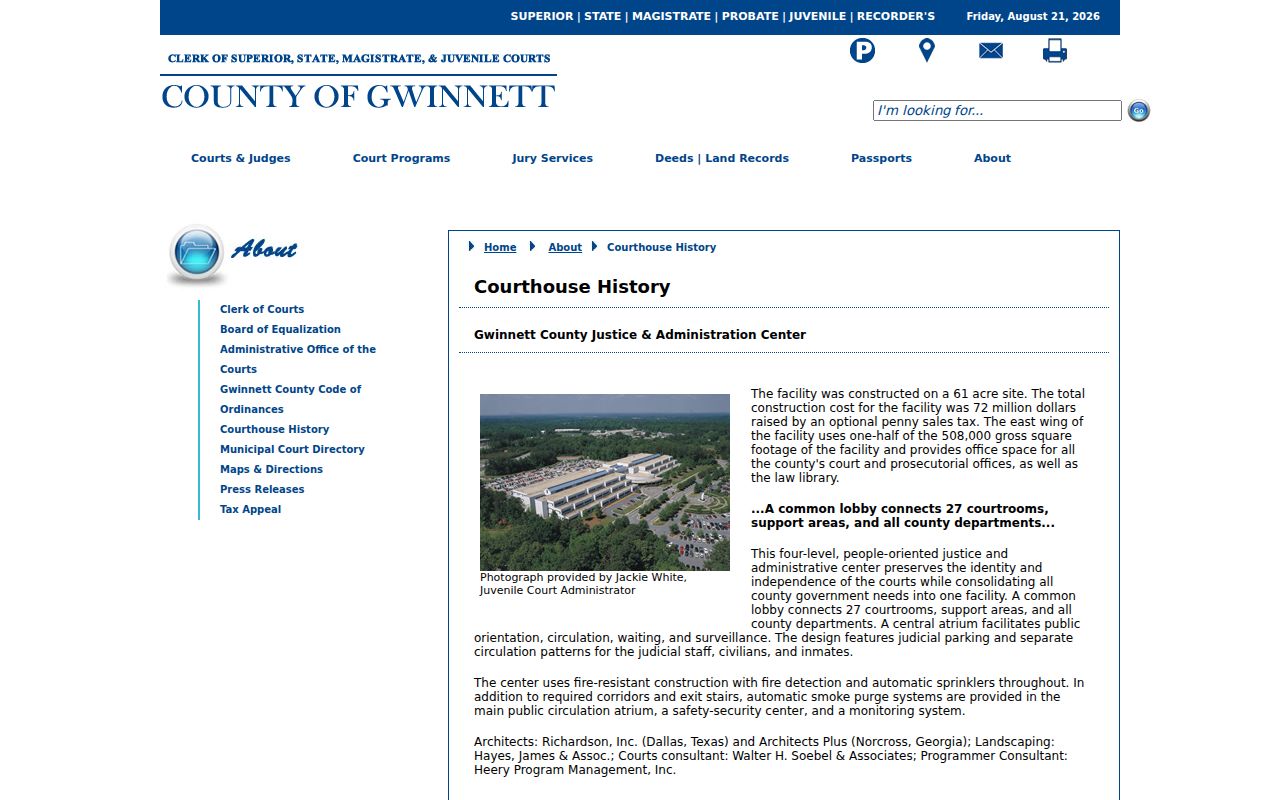
Why does the floor and room number matter as much as the street address? The Gwinnett court docket system runs across three buildings. A setting can land in any of them.
Counters are open weekdays from 8:00 a.m. to 5:00 p.m. Some filing windows shut at 4:30 p.m., though, so a quick call saves a wasted trip. The main Clerk line is 770-822-8100. Recorder's Court answers at 877-794-0988, and Juvenile Court can be reached at 770-619-6300.
Court Dates and Settings in Gwinnett County
Gwinnett County publishes court dates in several places, and each plays a different role. Docket events feed the picture. So do the State and Superior division calendars and Magistrate PDF indexes. One warning matters. The county says an online calendar date is not official until it is transmitted to the parties.
When sources conflict, trust the freshest document in hand. A summons, citation, notice, clerk-issued calendar, or direct word from a court coordinator or division controls. State Court lets you filter its calendar by case type, judge, or filename. Magistrate posts civil, dispossessory, default, garnishment, warrant, child-abandonment, and felony preliminary hearing calendars. Criminal calendars can list a calendar call weeks before the jury-trial week. The newest entry wins after a continuance or reset.
For a channel-by-channel workflow, see the Gwinnett County court schedule. Recheck press notices if severe weather or a temporary courtroom move could affect operations.
Gwinnett Docket Workload Context
Need a sense of scale for the Gwinnett County court docket? The official 2023 Superior Court Workload Assessment helps. It names 11 Superior Court judges. The three-year average is 1,818 cases per judge. The same calculation counts 6,084 average annual criminal defendants and 13,805 total civil cases. Gwinnett's reported 2023 population was 986,973, second among Georgia counties. The volume is no surprise.
Georgia Courts builds its dashboards from self-reported aggregate counts. They measure workload, not individual records. Anyone tracking one Gwinnett County court docket should stay with the docket portals and clerk channels, since a dashboard holds no searchable names.
Docket Access Under Georgia Law
Court rules and Georgia's open-government framework open the courthouse door. Even so, the office holding the record still sets the route. The county Open Records portal covers Recorder's Court among county departments. It expressly excludes Superior, State, and Magistrate Clerk records. Those requests go through Gwinnett Courts and the elected Clerk instead.
Some material stays closed. Sealed, juvenile, and protected items may be withheld. Nonexempt portions can come out with redactions, though.
Key Georgia sources:
Georgia Open Records Act guidance explains response timing, cost estimates, exemptions, and production of nonexempt portions.
Georgia court rules provide the current court-rule source, including public-access and courtroom procedures.
Uniform Superior Court Rule 21 addresses access and protection of sensitive information in the inspected rules.
Expect redactions to cover Social Security numbers, financial account data, medical information, and protected contact details. A public docket entry may still show that an event occurred even when the filing itself stays out of reach.
Gwinnett Court Entry Rules
A docket search can end at a clerk counter, so entry rules are part of practical access. The Gwinnett courthouse security page links Georgia's public-building weapons rule and spells out what visitors face at the doors.
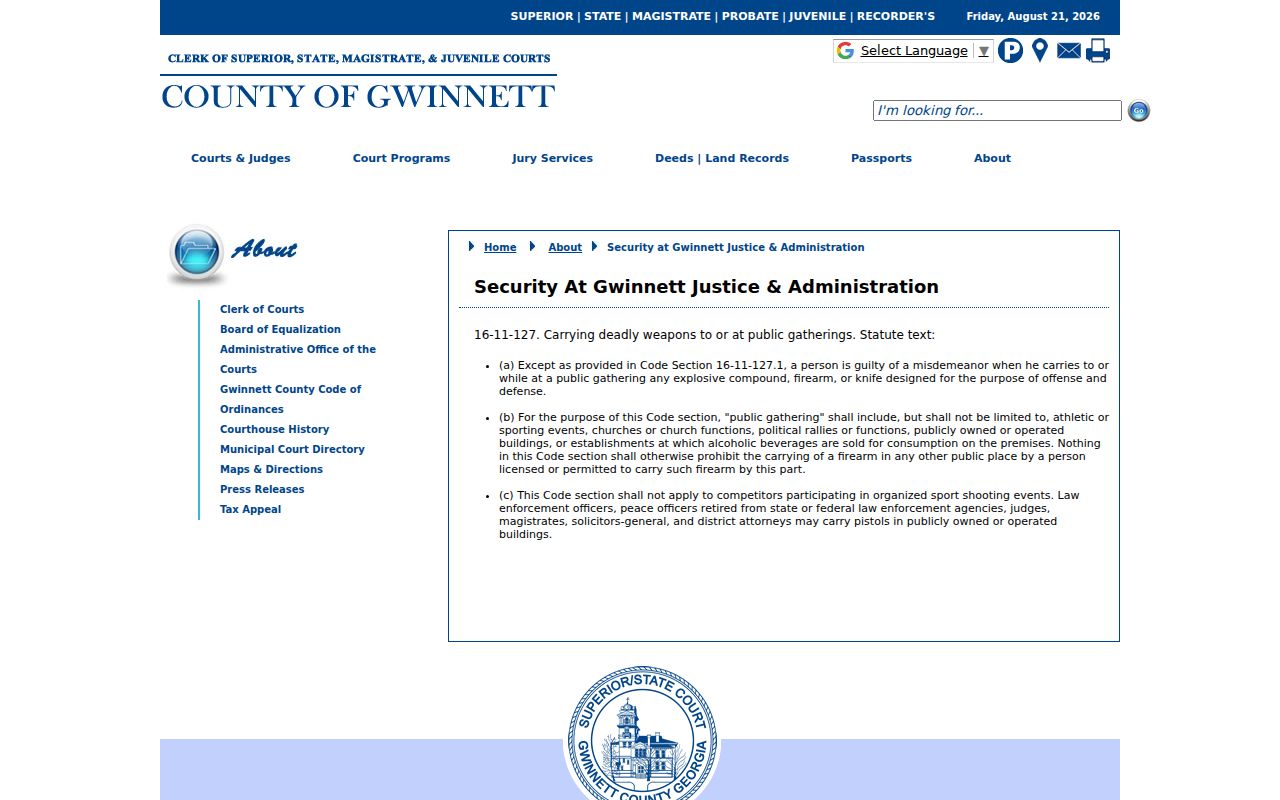
Plan for screening on any in-person visit. Bring only what the court permits, and check device rules for your assigned courtroom. Rule 22 governs recording devices in Superior Court, but local and municipal courts may set stricter limits. Interpreter Services at GJAC answers at 770-822-8574. The law library's number is 770-822-8571. Both offices support access to the court docket, though neither gives legal advice.
How the Clerk Keeps Docket Records
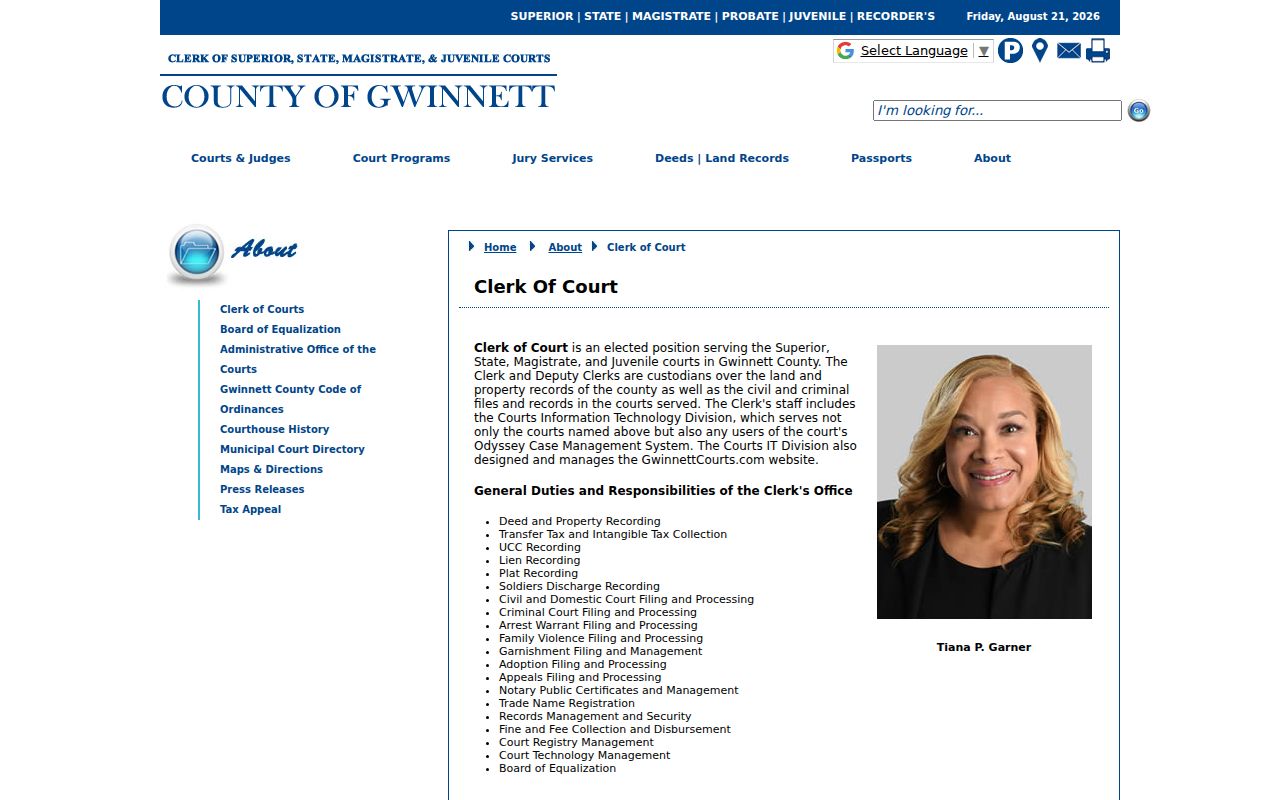
Tiana P. Garner, Clerk of Court and her deputy clerks keep the Superior, State, Magistrate, and Juvenile civil and criminal files. Filings, records, registry work, technology, and certified copies all run through that office. Probate runs its own records operation. Recorder's Court and each city municipal court keep separate files too.
That custody split decides where a request goes. The county Open Records portal cannot stand in for the Superior, State, or Magistrate Clerk when you need Gwinnett County court records.
Gwinnett Clerk of Court
75 Langley Drive
Lawrenceville, GA 30046
Mail: P.O. Box 880, Lawrenceville, GA 30046
770-822-8100
Gwinnett Docket Copies and Fees
A portal result helps research, but it is not certification. Ask the custodian what form you need: a plain copy, certified copy, disposition, or full file. Fees vary by court.
The published Superior and State schedules charge $2.50 for the first certified page, then $1.00 for each additional page. Magistrate lists a $14 certified copy. Probate public estate copies run $1.00 per page.
| Record Service | Published Amount |
|---|---|
| Superior certified copy, first page | $2.50 |
| Superior additional certified page | $1.00 |
| State certified copy, first page | $2.50 |
| Magistrate certified copy | $14.00 |
| Probate public estate copy | $1.00 per page |
Probate takes public estate requests at its office and by mail, with special notice rules for large pulls. Recorder's disposed citations may be destroyed after the retention period. When that happens, the clerk may issue an unavailable-disposition letter under a documented process.
Reaching Gwinnett Docket Counters
The official Gwinnett parking page shows the public deck and lot options around GJAC:
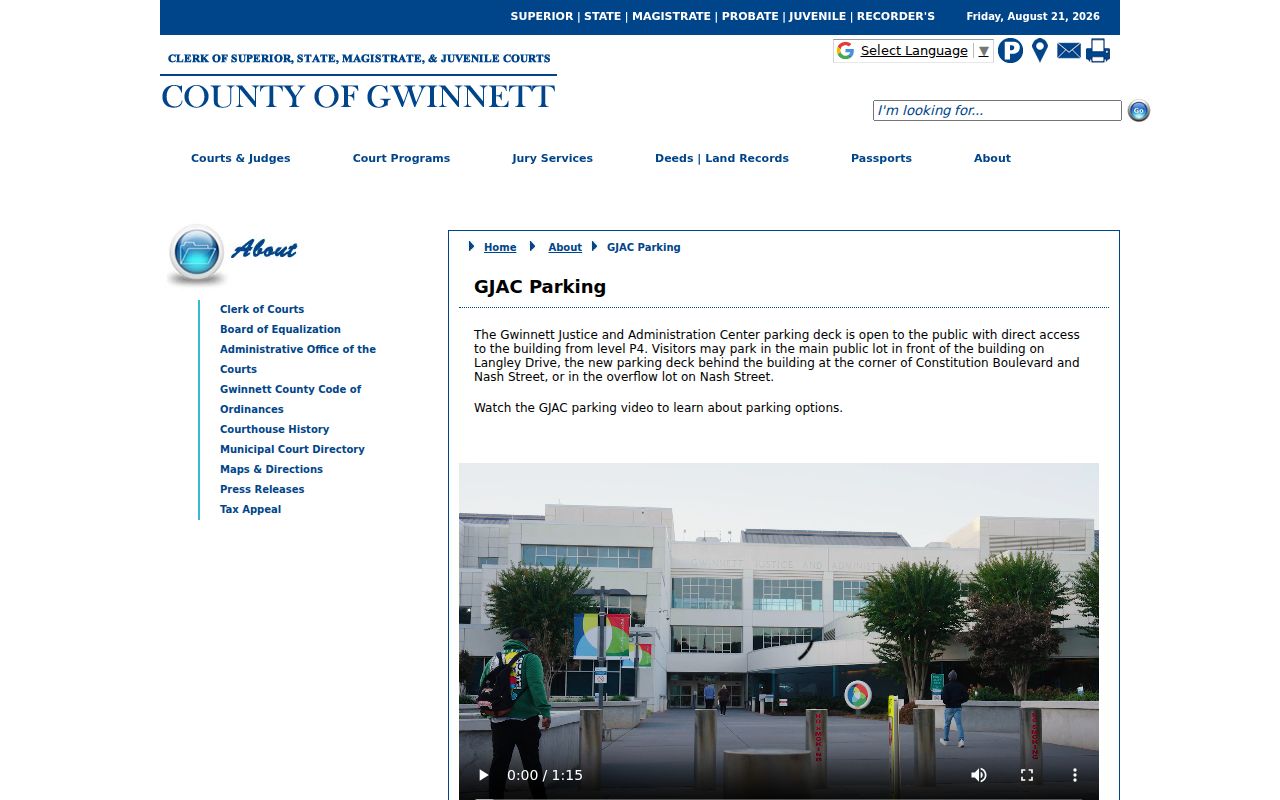
Getting to the right counter takes a little planning. Gwinnett offers the main Langley Drive lot, deck access, and overflow options the court describes. Confirm the current official source before you drive. Probate lobby computers open digitized archival books to the public. The clerk counter remains the sound fallback for an older paper file or a certified record.
Gwinnett Docket Terms in Plain English
Gwinnett pages use several terms for related but different records. Reading them carefully keeps a setting from being mistaken for an outcome.
- Docket entry
- A dated notation that a filing, event, order, or setting was added to the case register.
- Calendar call
- A scheduled session used to address readiness or case status. It may not be the trial itself.
- Continuance or reset
- A move to a later date. It does not by itself end the case.
- Disposition
- The recorded outcome or resolution of a charge, claim, or case.
- Certified copy
- A copy authenticated by the clerk as an official court record.
If a code is unclear, quote the exact entry to the clerk. Gwinnett publishes no single countywide dictionary of event codes.
City-by-City Court Dockets in Gwinnett County
A citation written inside city limits stays with that city's own municipal court. Peachtree Corners, Duluth, Lawrenceville, Sugar Hill, and Suwanee are the five largest incorporated cities. That count comes from the 2020 Census. Each one runs its docket its own way. That means a separate access route, calendar, payment setup, or clerk fallback depending on where the ticket came from.
Things change for citations from County Police, the Sheriff, DDS, DOT, or under county code. Those all land in Gwinnett Recorder's Court instead.
Peachtree Corners Court Records
42,243 residents. Fourth-Friday municipal calendar and JusticeONE access.
Duluth Court Records
31,873 residents. City court, JusticeONE, and JustFOIA routes.
Lawrenceville Court Records
30,629 residents. City Hall court and GovernmentWindow payment route.
Sugar Hill Court Records
25,076 residents. Ordinance court and clerk-confirmed hearing dates.
Suwanee Court Records
20,786 residents. Wednesday settings with phone and counter fallback.
Note: Population ranks measure how big a city is, not how full its docket is. For aggregate counts, Georgia's municipal dashboard is the right source.
Map and Directions to the Gwinnett Justice and Administration Center
Superior, State, Magistrate, and Juvenile-Court filings tied to the Clerk of Court are kept at the Gwinnett Justice and Administration Center (GJAC), 75 Langley Drive, in Lawrenceville. The Clerk's office sits on the first and third floors, Superior Court on the third floor, and State Court on the second; the building is open Monday through Friday, 8:00 a.m. to 5:00 p.m., though new-filing counters and Probate close at 4:30 p.m. Juvenile Court and Recorder's Court are in a separate building at 115 Stone Mountain Street, and Magistrate criminal functions also operate from the Detention Center Court Annex at 2900 University Parkway.
Gwinnett Clerk of Court
75 Langley Drive
Lawrenceville, GA 30046
770-822-8100
Monday through Friday, 8:00 a.m. to 5:00 p.m.
Parking is available in the GJAC deck, the main Langley Drive lot, and additional decks at Constitution Boulevard/Nash Street, with a Nash Street overflow lot. Visitors should expect security screening under Georgia's public-building weapons law, and division hours can vary, so call 770-822-8000 to confirm before a trip.